S3-FIFO
Scalable and Efficient Cache Eviction
Efficient: up to 72% lower miss ratio than LRU
Robust: evaluated on 6594 workloads from 12 companies
Scalable: NO locking
Simple: FIFO queues only
Flash-friendly: sequential writes only
How does S3-FIFO work?
Simple and Scalable caching with three Static FIFO queues
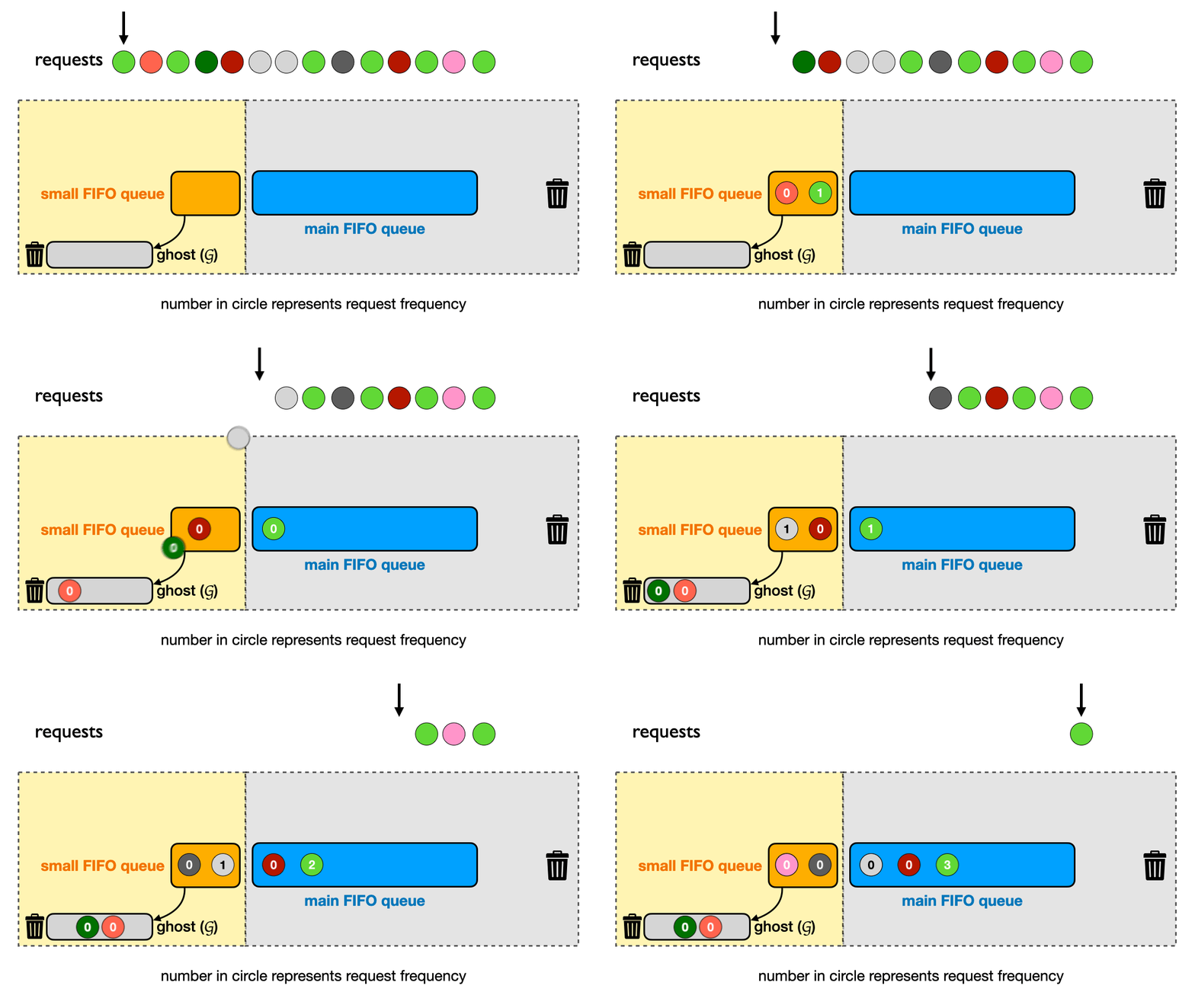
- New objects enter a small FIFO queue that holds about 10% of the cache.
- When the small queue is full, its oldest object moves to the main queue if it was requested again; otherwise it is evicted, and only its key is kept in a ghost queue.
- A miss on a key in the ghost queue inserts the object straight into the main queue.
- The main queue evicts from its tail but gives objects that were reused another pass. A hit only bumps a small counter, so nothing is locked or moved on the hot path.
How good is S3-FIFO?
S3-FIFO reduces your LRU cache size by 46% and improves the throughput by 6x
* target miss ratio 10%, 16 threads
How to use
# pip install cachemonCache
from cachemonCache import S3FIFO

# A cache that holds up to 1,000 objects
cache = S3FIFO(cache_size=1000)

# Add an object; it expires after 60 seconds
cache.put("key", "value", ttl_sec=60)

# Look it up
print(cache.get("key"))   # value
print("key" in cache)     # True

# Remove it
cache.delete("key")
print(cache.get("key"))   # None

# It also behaves like a dict
cache["answer"] = 42
print(cache["answer"])    # 42
In your language
Production cache libraries that implement S3-FIFO.
 foyer
foyer  TinyUFO
  golang-fifo
  samber/hot
  otter
otter  spica
spica  libCacheSim
 Why does S3-FIFO work?
A huge number of objects accessed once (called one-hit wonders) calling for quick demotion:
S3-FIFO quickly removes objects that will not be accessed in the future
Figure shows that most of the objects evicted by LRU spend long time in the cache without reuse.
Adoption
Systems running S3-FIFO
 Apache Traffic Server
 YDB
YDB InfluxDB 3
 Redpanda
 RisingWave
 vLLM AIBrix
 Feldera
 ZeroFS
 Deep Graph Library
 MatrixOne
 Pelikan
 Linera
 Buildkite content-cache
 Flowtide
 uap-python
Running S3-FIFO-like eviction through quick_cache — its README names S3-FIFO; its docs call it a Clock-PRO variant “very similar to” S3-FIFO
 X recommendation algorithm
 Next.js Turbopack
 PostHog
 SurrealDB
 Servo
Servo Windmill
 Sui
Sui Aptos
Aptos Lance
Lance AWS LLRT
 Warpgate
 agentgateway
 TrailBase
 Fjall
Fjall Forest
 Fuel Core
 rustic
 Loro
Loro Icechunk
 Stalwart
In progress upstream — open pull requests and proposals
 RocksDB
 OpenSearch
 rustls
 389 Directory Server
 Qdrant
 Designs inspired by S3-FIFO
 Syndica Sig
More implementations
 quick-cache
  s3-fifo
  S3-FIFO
  s3fifo
  go-s3-fifo
  s3fifo.py
  s3fifo_cpp
  S3-FIFO
  s3fifo
  S3FCache
  ziglang-caches
  s3-fifo-cache
 Discussed and written about
Shipped S3-FIFO somewhere? Tell us — we would love to list you, and to hear how it went.
Acknowledgement
Sponsors:
Carnegie Mellon University Parallel Data Laboratory Emory University SimBioSys Lab
Meta, Google Cloud, AWS, Microsoft Azure, CloudLab, Sloan Foundation, VMware, and NSF
Dataset source:
Twitter, Meta, Tencent, Microsoft, Wikimedia, CloudPhysics
Contact Us